
Back in the 1920s, a tourist village named Villa Epecuen was established along the shore of Lago Epecuen, a salt lake some 600 kilometers southwest of Buenos Aires, Argentina. Lago Epecuen is like most other mountain lakes, except for one important difference. It has salt levels second only to the Dead Sea, and ten times higher than any ocean.
Lago Epecuen’s therapeutic powers have been famous for centuries. Legend holds that the lake was formed by the tears of a great Chief crying for the pain of his beloved. It is said that Epecuen — or “eternal spring” — can cure depression, rheumatism, skin diseases, anaemia, even treat diabetes.

By late nineteenth century, the first residents and visitors started to arrive to Villa Epecuen and set up tents on the banks. Villa Epecuen transformed from a sleepy mountain village to a bustling tourist resort. The village soon had a railway line linking it to Buenos Aires. Before long, tourists from all over South American and the World came flocking, and by the 1960s, as many as 25,000 people came every year to soak in the soothing salt water. The town’s population peaked in the 1970s with more than 5,000. Nearly 300 businesses thrived, including hotels, hostels, spas, shops, and museums.
Around the same time, a long-term weather event was delivering far more rain than usual to the surrounding hills for years, and Lago Epecuen began to swell. On 10 November 1985 the enormous volume of water broke through the rock and earth dam and inundated much of the town under four feet of water. By 1993, the slow-growing flood consumed the town until it was covered in 10 meters of water.
Nearly 25 years later, in 2009, the wet weather reversed and the waters began to recede. Villa Epecuen started coming back to the surface.
No one returned back to the town, except 81-year-old Pablo Novak who is now Villa Epecuen’s sole resident.
“I am OK here. I am just alone. I read the newspaper. And I always think of the towns golden days back in the 1960s and 70s,” Novak says.
In 2011, AFP photographer Juan Mabromata visited the ruins of Villa Epecuen, met its sole inhabitant, and returned with these images.


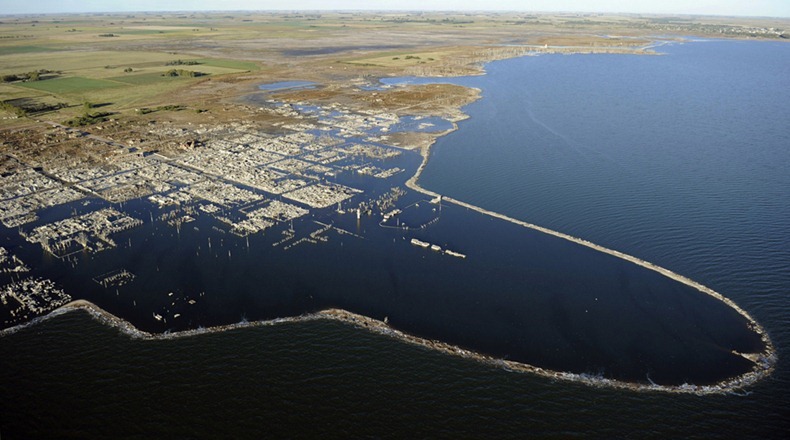


The former slaughterhouse of Villa Epecuen, Argentina, among a stand of long-dead trees, photographed on May 4, 2011.

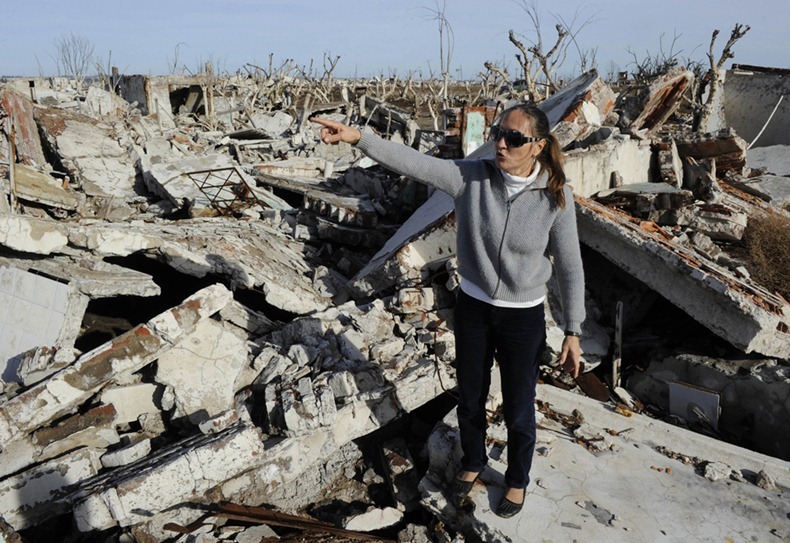
Norma Berg gestures next to the ruins of her family house in Villa Epecuen, Argentina, on May 3, 2011.


A thin layer of salt, cracked, revealing the original paint of the wall of a collapsed building in Villa Epecuen, Argentina, on May 3, 2011.


Lone inhabitant of Villa Epecuen, 81-year-old Pablo Novak tends his wood stove at his on May 3, 2011.
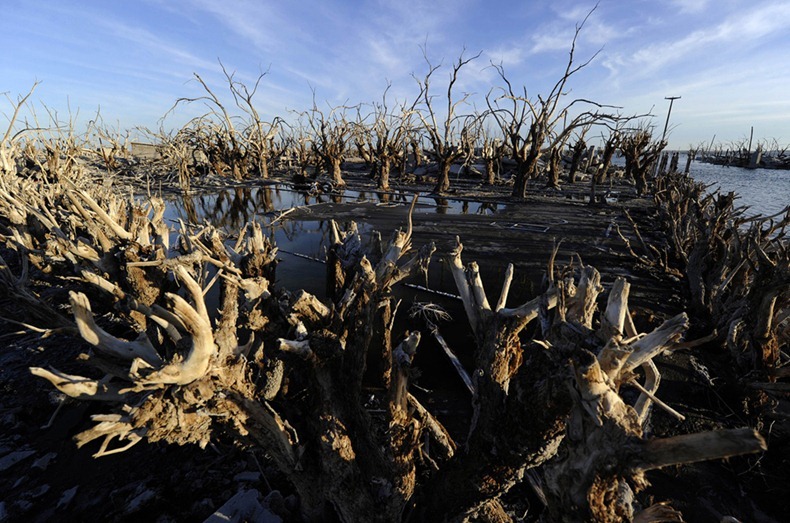

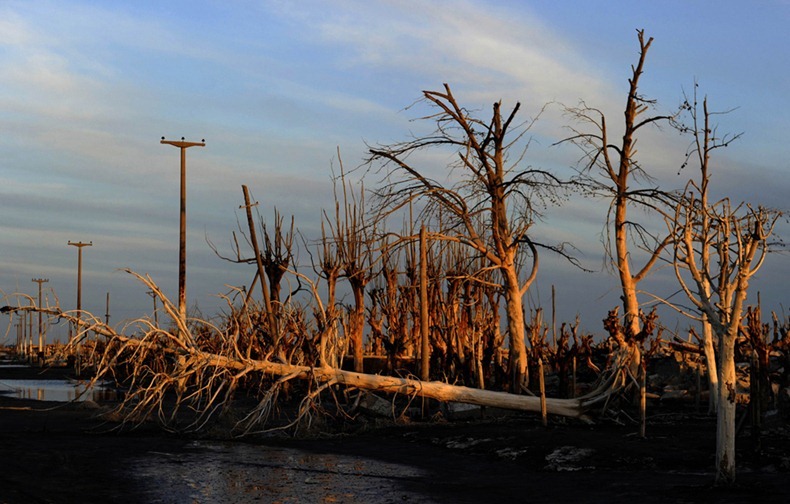


The road leading to the cemetery of Carhue, near Villa Epecuen, at sunset on May 4, 2011.

A man compares a photograph of Villa Epecuen taken in the 1970's with the current state of the place, after almost 25 years beneath the water of Lago Epecuen.
Sources: The Atlantic, Wikipedia, Lostresorts


Really. Really cool. Thanks for posting these!
ReplyDeletewhy are all the buildings fallen down?
ReplyDeleteI-)
That's a good question. Perhaps the steal rebar has corroded thru due to it being a salt lake? This would weaken the structures to the point of failure.
DeleteBecause of salt.
DeleteYes it's a chemical reaction
DeleteThe salt causes rebar to expand and crack the concrete plus relentless erosion from the flow of the lake.
DeleteCorrosion plus the weight of the water itself.
DeleteOr maybe it's just that the waters flooded the village violently like a mini tsunami.
DeleteIn any case, it looks like it has been nuked rather than flooded.
DeleteSalt.
DeleteI live on a beach. And we have to wash our cars regularly due to salt, or it will rust the bottom.
I could only imagine what this excessive salt lake did.
Why pH is important
DeletepH is a critical factor in the chemistry of concrete. Portland Cement, the “binding” component in concrete, (the other components being rock [aggregates] and water) has a pH approaching 11, which is very alkaline. If you remember your high school chemistry, neutral pH is 7. Above 7 is alkaline, and below 7 is acidic. In order for the cement to hold together the other components, it is important for it to remain at or near a pH of 11.
When salt (pH of roughly 6 to 7) or other acids, such as acid rain, are introduced onto (and therefore “into” as well) the concrete, they enter into the small pores and micro-cracks of the concrete and attack the surrounding materials, lowering their pH. As the pH is lowered, the cement’s ability to hold things together is compromised. Exposed to acidic environments for a long enough period of time, and all that will be left is sand and rock.
Failure due to corrosion of reinforcement
Even concrete that is not subjected to de-icing salts is subjected to a process that lowers pH. The process is called “Carbonation.” Carbonation is a reaction between the cement in concrete and carbon dioxide in the air. Carbonation progressively lowers the pH in concrete, though the process is somewhat slow (about 6 years to progress 50mm or 2 inches). When carbonation (lowered pH) reaches the level of the steel reinforcement, it attacks the thin protective layer of iron oxide surrounding the reinforcement and initiates corrosion. Since steel can expand up to 6 times its size when corroding, the resulting pressure can cause the surrounding concrete to crack and break. In structural concrete, this can result in structural failure.
If he's all alone, where does he get the newspaper?
ReplyDeleteThere is a city 13km away, most likely that is his source of news and supplies.
DeleteGlad I'm not the only one thinking that. Poor paperboy...
DeleteThis is really neat.
ReplyDeletenature remains to surprise every time such stories are found in horror movies only.
ReplyDeleteWhat is the climate like! Do they have any natural resources?
ReplyDeleteYes salt
DeleteWhat surprises me most is how that car has had its entire body eliminated. I know that steel slowly gets thiner and thiner in salt water but that's a very slow process (for example, Titanic has been on the bottom of the sea for a whole century yet it's still recognizable), so I find it hard to believe that the corrosion alone has done that in "only" 25 years.
ReplyDeleteThe Titanic sits in deep, cold water with very little oxygen. This lake would be shallow, with 10 x the salt (10 x the number of free ions to make corrosion happen) and because the lake is shallow with lots of surface area, it also has more oxygen and is warmer. Warmer means that the atoms have more energy to make new bonds. So this salty, warm, oxygen rich lake would have been a perfect place for iron atoms to form iron oxide molecules (rust).
DeleteAll yall niggas scientist now ??
ReplyDeleteI'm guessing not, it doesn't take a scientist to know that salt corrodes rebar over time. Pick up a book? Perhaps someday, you too, can be as knowledgable as these fine people. Probably not though, considering you have horrible grammar and just referred to everyone on this feed as "nigga scientists". Good luck though!
ReplyDeleteWell said!
Deleteyou nailed it...!!!
DeleteInferiority complex syndrome. Usually for someone who is bully with bad academic result in school
ReplyDeleteIn past there must be some beautiful villas all around. But who knows about future after that deadly flood changes the whole picture of town. Hope this could not happen again with those who lived and try to make new villa in argentina towns.
ReplyDeleteWhere did they put all the FEMA Trailers?
ReplyDeleteMy five cents on the topic, the author says that Lago Epecuén is " like most other mountain lakes", actually the lake is situated on flat land, is the typical shallow lake from the pampas. There is a similar one called Mar Chiquita (Little Sea) on my province, Córdoba, wich is next to Buenos Aires. If you see the aerial shots of the place, you'll see what i'm talking about.
ReplyDeleteAn extra tip, there is a movie called "And Soon the Darkness" that was filmed there, avoid it at all costs, mind my words.
Rust in peace
ReplyDeleteI wonder why the wheel rims lasted so well? The rims are much thicker than the car's body, but much thinner than that engine's head, which is completely gone. For some reason, the valves have done better than the block, whatever alloy they may be. Maybe the block head was already removed before the flooding? That could make sense, as the car was probably abandoned before the flooding, since it does not look like there are any other cars in town, as far as I can see in the pictures. Also, what is with the ship??
ReplyDelete